Essex County Council's verdict on Rochford's Local Plan: must do better
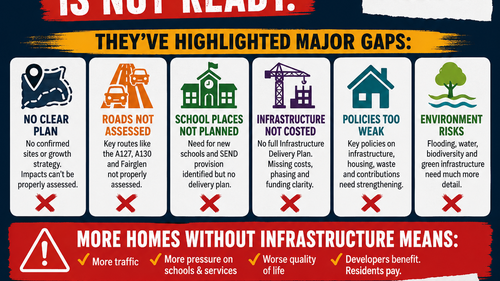
Essex County Council has published its formal response to Rochford District Council's draft Local Plan. It runs to 71 pages. We've read the lot, so you don't have to.
The short version? Four policy areas failed outright. Four are weak. Only four passed — and even those need amendments. The plan isn't ready for its next stage, and the clock is ticking.
What is this response?
Every local council has to produce a Local Plan. It's the document that decides where homes get built, what infrastructure is needed, and how the area develops over the next 20 years. Rochford published its draft plan (called Regulation 18) in February 2026 and invited responses.
Essex County Council isn't just any consultee. As the highways authority, education authority, minerals and waste authority, lead flood authority, and public health adviser, ECC has to sign off on the evidence underpinning the plan. If ECC says the evidence isn't good enough, the plan won't survive examination by a government inspector.
That's exactly what ECC is saying across several policy areas.
The fails
Transport evidence — FAIL
This is the most damaging finding. ECC says the Regulation 18 Transport Assessment is not fit for purpose at Regulation 19 stage. That's not a minor quibble. Without a sound transport evidence base, the plan cannot be submitted.
The specific problems: no cumulative cross-boundary modelling of growth impacts, no proper analysis of strategic road impacts on the A127, A13, A130, Fairglen Interchange, or Sadlers Farm roundabout. ECC notes that the junction modelling already shows "a concerning extent of impacts" that can't be addressed without "extremely ambitious transport mitigations" — and the draft plan contains nothing ambitious.
For residents stuck in traffic on the A127 or waiting years for the Fairglen Interchange, this confirms what you already know. The council hasn't done the work to understand what thousands of new homes will do to roads that are already failing.
Site assessment methodology — FAIL
ECC doesn't support the approach taken in the Site Assessment Methodology because it completely ignores minerals and waste. The Minerals and Waste Planning Authority provided site assessments back in 2021. They were ignored. ECC has resubmitted a RAG (red/amber/green) methodology showing which proposed sites fall within Mineral Safeguarding Areas, Mineral Consultation Areas, and Waste Consultation Areas.
If you're assessing whether a site is suitable for housing and you haven't checked whether it sits on top of a protected mineral reserve or next to a waste facility, your methodology has a fundamental gap. That's what ECC is telling Rochford.
Infrastructure delivery — FAIL
Policy MG4 is supposed to define how developer contributions fund infrastructure. ECC says it doesn't even define what infrastructure means.
The omissions are significant. Supported and specialist housing isn't mentioned as infrastructure requiring delivery or contributions. Waste and waste disposal are absent. Early years and childcare are lumped under "education" without a proper definition, which matters because ECC has distinct statutory duties for childcare under the Childcare Act 2006. Cumulative impacts from multiple developments aren't addressed.
Without these definitions, there's no mechanism to make developers pay for the infrastructure new communities need. The cost falls on the public purse — on you.
Specialist and supported housing — FAIL
ECC completed a Supported and Specialist Housing and Accommodation Needs Assessment (SSHANA) in 2025. It identifies the specific needs of older people, people with dementia, learning disabilities, autism, and sensory impairments across Rochford.
The draft Local Plan doesn't reference this assessment. Policy H1 doesn't set a proportion for M4(3) wheelchair-accessible homes. There are no dementia-inclusive design requirements. The Infrastructure Delivery Plan lists some adult social care needs under "Health and Wellbeing" but doesn't translate them into deliverable requirements with triggers, phasing, or delivery mechanisms.
For the growing number of older residents in Rochford who need accessible, purpose-built housing, the plan offers no assurance that it will be delivered.
The weak areas
Education planning — WEAK
ECC completed education scenario testing in August 2025, identifying the need for new school land at three locations: Land West of Rayleigh (new secondary school), King Edmund School expansion (Land East of Rochford), and Land North of Southend (new secondary school). The draft plan doesn't reference this work.
SEND provision is flagged as a strategic cross-boundary matter that needs engagement with Basildon, Castle Point, and Southend. Early years and childcare are repeatedly noted as missing from policy wording.
With 74% of Rochford designated as Green Belt, ECC also raises a practical problem: every school expansion currently requires demonstrating "very special circumstances" under Green Belt policy. They want the plan to redesignate education land to remove this barrier.
Large-scale site policy — WEAK
The draft plan identifies sites of 1,400+ homes for further testing but has no policy framework for delivering them. No stewardship arrangements, no housing mix requirements, no infrastructure delivery mechanisms, no cross-boundary coordination.
ECC specifically flags Land North of Southend (CFS260) and Dollymans Farm (CFS222a) as strategic cross-boundary matters. For Dollymans Farm in particular — a site that could see up to 1,300 homes on the Rawreth/Wickford boundary — the absence of coordinated planning with Basildon is a serious gap.
Design quality — WEAK
ECC describes the design policy (SC6) as "quite brief and limited" compared to other local plans. They propose extensive rewording across almost every bullet point, adding requirements for landscape character, inclusive design, school environments, and waste infrastructure.
The BREEAM Excellent standard for non-residential development over 500 sqm sits in the reasoned justification text rather than the policy itself. That distinction matters: if it's not in the policy, it can't be enforced.
Southend Airport — WEAK
No aerodrome safeguarding policy exists in the draft plan. ECC points to the Uttlesford Local Plan, where inspectors supported a specific safeguarding policy for Stansted Airport, and suggests Rochford adopt a similar approach for Southend.
Night noise controls are absent. ECC wants the ICAO Balanced Approach to aircraft noise management embedded in policy, with specific reference to operating restrictions and hours of operation. For residents near the airport who have concerns about changes to night flights, the current policy offers no protection.
The passes
Credit where it's due. Four areas broadly passed ECC's assessment.
**Climate and net zero** policies (SC2 and SC3) reflect the Greater Essex model policies that were found sound at the Uttlesford Local Plan examination. Minor corrections to wording and evidence references are needed, but the approach is right.
**Biodiversity and green infrastructure** policies are supported, including the mandatory 10% Biodiversity Net Gain and the LNRS-led hierarchy. ECC wants to strengthen cross-boundary networks and long-term management plans, but the foundations are there.
**Water efficiency** gets strong backing. ECC supports the 85 litres per person per day target for new homes and wants non-residential standards tightened to match the Shared Standards report. Essex is classified as a "severely water stressed" area, so this matters.
**Health and wellbeing** policy MG3 is welcomed, particularly the Health Impact Assessment requirements. The hot food takeaway provisions need more evidence and better alignment with school location policies, but the intent is supported.
What happens next
Rochford District Council has to submit this plan for examination by December 2026. That's eight months away.
ECC is telling them to redo the transport evidence, revise the site assessment methodology, rewrite the infrastructure delivery policy, add specialist housing requirements, develop a large-scale sites policy, strengthen the design policy, and add aerodrome safeguarding for the airport.
If Rochford misses the December 2026 deadline, the plan falls under the new planning system with different rules and potentially years of additional delay. During that time, the district remains vulnerable to speculative development — the kind of unplanned, poorly-serviced housing that residents rightly object to.
This plan has been years in the making under Conservative leadership at Rochford District Council. The evidence base isn't there. The policies aren't strong enough. And the council that's supposed to be protecting residents from inappropriate development hasn't done the groundwork to make that protection stick.
Residents deserve a Local Plan that works. Right now, they don't have one.
*The full ECC response (Appendix 1, 71 pages) is available here.